
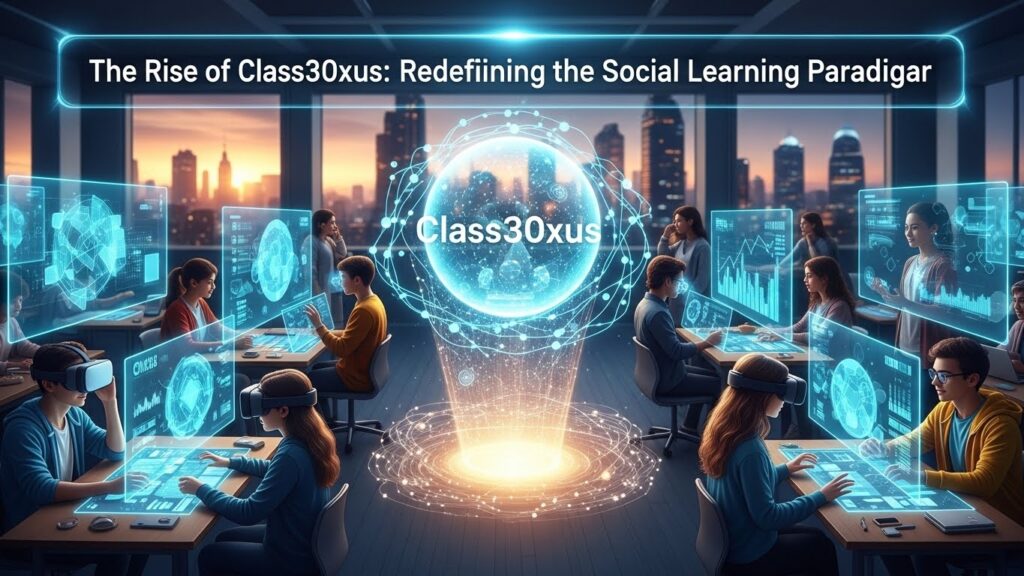
In the ever-evolving landscape of education technology and online communities, a new keyword has begun to surface in niche forums, developer circles, and forward-thinking corporate training departments: Class30xus. More than a mere buzzword, Class30xus represents a burgeoning philosophy and methodology for social learning in the 21st century.
Decoding the Term
At its simplest, “Class30xus” can be parsed as a compound concept: “Class” (a learning group), “30x” (suggesting exponential acceleration or 30-fold magnification), and “us” (emphasizing community and collective intelligence). It describes a hyper-efficient, community-driven learning model where a cohort of individuals leverages networked intelligence to achieve mastery at an accelerated pace, far beyond what any single learner could accomplish alone.
Core Principles of the Class30xus Model
- Exponential Knowledge Velocity: The traditional linear learning path is replaced by a networked one. When one member of the cohort discovers a key insight, a resource, or a solution, it is instantly contextualized and disseminated across the network, multiplying its value for all. The “30x” isn’t a literal guarantee, but a symbol of dramatic efficiency gains.
- Distributed Expertise: A Class30xus group operates less like a classroom with one teacher and more like a hive mind. Each member contributes from their unique perspective, professional background, or skill set. The programmer, the designer, the writer, and the strategist all teach and learn from each other simultaneously.
- Project-Based, Real-World Catalysis: Learning is not theoretical. A Class30xus forms around a concrete, ambitious outcome—building an application, solving a complex environmental challenge, launching a micro-business. The project is the curriculum, and progress is measured in tangible results.
- Technology as a Synapse: The model is enabled by a suite of tools: real-time collaboration platforms (like Figma, Notion, or Coda), community hubs (like Discord or Circle), and knowledge repositories that are continuously curated by the group. The tech stack acts as the central nervous system.
- The “Us” is Sovereign: Success is defined collectively. There is no single gatekeeper of knowledge. Governance, pace, and direction are often determined collaboratively, fostering extreme ownership and engagement from every participant.
Where Class30xus is Emerging
- Bootstrapped Startups: Small teams using the model to cross-train and pivot rapidly, with each member becoming a force multiplier.
- Advanced Online Cohorts: The next generation of bootcamps and online courses are experimenting with this structure, moving from passive video consumption to active, collective creation.
- Corporate “Skunkworks” Teams: Innovative departments within larger companies are adopting Class30xus principles to foster intrapreneurship and break through silos.
- Open-Source Projects: Naturally aligned with the collaborative, meritocratic, and project-driven ethos of the open-source world.
The Challenges
The model is not without its hurdles. It requires a high degree of intrinsic motivation, exceptional communication, and a cultural commitment to psychological safety and reciprocity. Without careful curation or a clear foundational framework, groups can falter. The “30x” acceleration depends entirely on the quality of participation and the strength of the initial design of the learning “organism.”
The Future is Collective
Class30xus stands as a direct response to the isolation of passive online learning and the rigid structures of traditional education. It posits that the most powerful educational resource in any room—or any Slack channel—is not the expert at the front, but the collective potential of the group itself, properly organized and activated.
As we move further into an era defined by information abundance and complex, interdisciplinary problems, methodologies like Class30xus offer a compelling blueprint. It suggests that the key to personal and professional mastery in the coming decades may not be about studying harder in isolation, but about learning smarter, together.